Best Pillow Thickness for Side Sleepers (With Shoulder Width Examples)
You’ve probably woken up with a stiff neck more times than you’d like to admit. The culprit? Your pillow’s thickness doesn’t match your shoulder width.
If you’ve got 15-inch shoulders and you’re using a 3-inch pillow, your head drops too low and your neck bends sideways all night. That explains the morning pain.
The fix isn’t complicated, but you’ll need to know your actual measurements first.

- REVOLUTIONIZE YOUR SLEEP WITH THE INNOVATIVE HOLLOW CONCAVE DESIGN - Tired of waking up...
- EXPERIENCE UNINTERRUPTED, BLISSFUL SLEEP WITH OUR VERSATILE PILLOW - Engineered with...

- REVOLUTIONIZE YOUR SLEEP WITH THE INNOVATIVE HOLLOW CONCAVE DESIGN - Tired of waking up...
- EXPERIENCE UNINTERRUPTED, BLISSFUL SLEEP WITH OUR VERSATILE PILLOW - Engineered with...

- Cervical Neck Pillow for Pain Relief - Contour Memory Foam Pillows for Sleeping, Ergonomic...
- [Two Perfect Heights (5.5" & 4.1") - Flip for Your Ideal Sleep Position] Tired of pillows...

What Happens to Your Spine When Pillow Thickness Is Wrong?
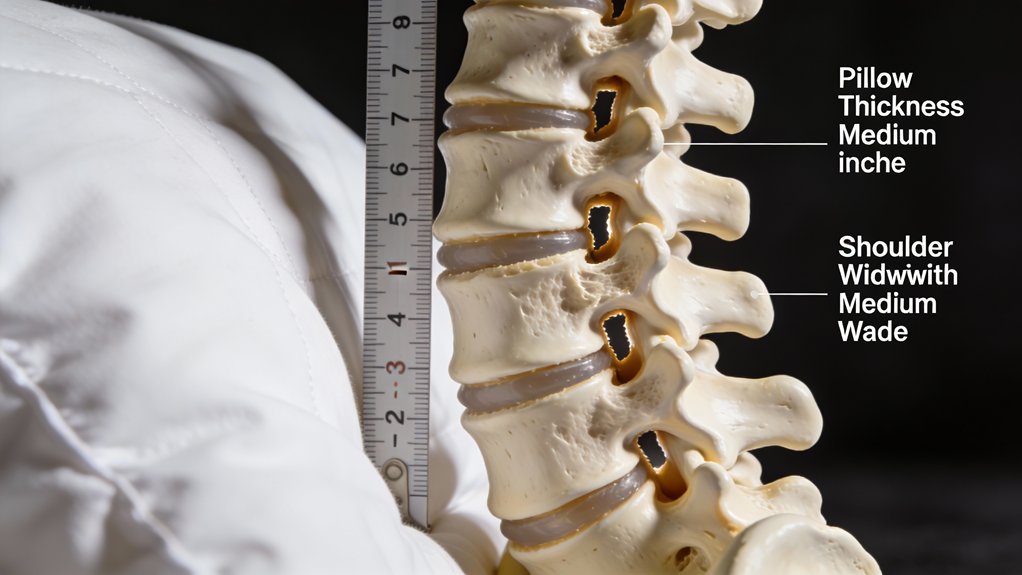
When you rest your head on a pillow that’s the wrong thickness, your spine pays the price almost immediately.
Your spine reacts instantly to improper pillow thickness, setting off a chain reaction of misalignment and discomfort throughout your body.
A pillow that’s too high tilts your head upward, straining your neck muscles and potentially triggering tension headaches.
Too low, and the gap between your head and mattress won’t fill properly, forcing your neck to bend unnaturally. This misalignment affects everything from your shoulders down to your hips.
Without proper pillow support maintaining that vital 10 to 15 cm range, you’re setting yourself up for discomfort.
Your spine alignment depends on matching pillow thickness to your body’s specific needs. Pillows are integral for maintaining spinal alignment and enhancing overall comfort during sleep.
How to Measure Shoulder Width for Pillow Thickness
Your shoulder width holds the key to finding the right pillow thickness. You’ll need two shoulder measurement techniques to get accurate results.
Stand upright while someone measures from the outer edge of one shoulder to the other using a flexible measuring tape. Alternatively, lie on your back and have them measure between shoulder tips in a straight line.
The importance of alignment becomes clear once you know your measurement. Wider shoulders (over 16 inches) need higher loft pillows exceeding 5 inches. Proper alignment supports better sleep quality and helps prevent the neck pain and stiffness that can develop from using inadequate pillows.
Medium widths (14-16 inches) work best with 3-5 inch pillows. Narrower shoulders under 14 inches require low loft options.
Best Pillow Thickness by Shoulder Width
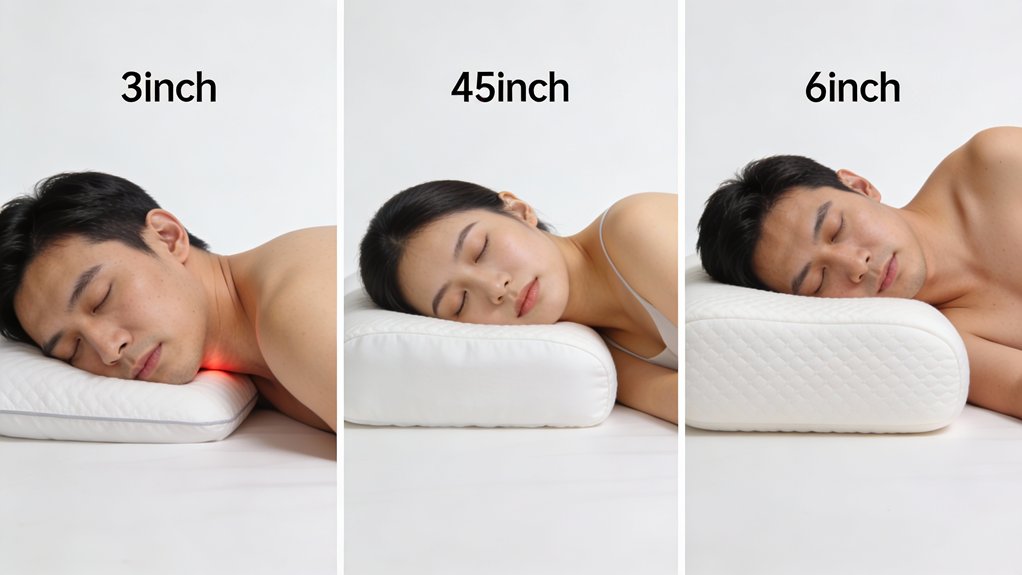
Three distinct shoulder width categories determine which pillow thickness will keep your spine aligned through the night.
If your shoulders measure under 14 inches, you’ll need a medium loft pillow between 3 to 5 inches thick.
Average shoulder width of 14 to 16 inches requires a medium to high pillow loft ranging from 5 to 6 inches.
Broader shoulders over 16 inches demand a high loft pillow of 6 inches or more.
These measurements translate to roughly 10 to 15 cm in pillow height.
Testing different pillow lofts remains essential since your comfort preferences and body characteristics affect which thickness works best.
Memory Foam vs. Down: Which Needs a Thicker Pillow?
Pillow material changes how thick your pillow needs to be, even when your shoulder width stays the same.
Memory foam benefits include contouring support that adapts to your neck shape, requiring 4 to 6 inches of loft for proper spinal alignment.
Down pillow softness feels luxurious but compresses more under weight.
Consider these thickness guidelines:
- Wide shoulders (over 5 inches apart): Choose high-loft memory foam exceeding 5 inches to fill the gap between your head and mattress.
- Narrow shoulders: Select medium-loft down at 3 to 5 inches for comfortable elevation.
- Standard builds: Either material works at 4 to 5 inches, depending on your firmness preference.
Firm vs. Soft Mattress: Add or Subtract Pillow Height?

When you sink into a soft mattress, the gap between your head and the sleep surface shrinks dramatically compared to sleeping on a firm one.
That’s why pillow height needs adjustment based on mattress firmness.
On firm mattresses, you’ll need thicker pillows, typically above 5 inches if you have broader shoulders.
Softer mattresses compress under your weight, reducing the space your pillow must fill. This means medium loft (3 to 5 inches) often works better.
Your mattress fundamentally does part of the pillow’s job by allowing your shoulder to sink in, so you’re subtracting height rather than adding it.
How to Tell if Your Pillow Thickness Is Right
How do you know if you’ve found the right pillow height? Check these three key indicators of proper pillow alignment:
- Your head aligns with your spine, it shouldn’t tilt up or down when you’re lying on your side.
- You wake without neck or shoulder pain, morning discomfort signals your pillow’s too high or too low.
- Your sleep posture feels natural, you’re not adjusting constantly throughout the night.
Test different loft levels over several nights.
Side sleepers with broad shoulders typically need over 5 inches, while position-shifters do better with 3 to 5 inches.
Your mattress firmness also matters.
Can You Adjust Pillow Thickness at Home?

You don’t need to buy a new pillow every time the thickness feels wrong. Adjustable pillows let you add or remove filling to customize the loft, typically between 10 to 15 cm for side sleepers.
If your pillow isn’t adjustable, temporary solutions work well: place a folded towel or blanket underneath to increase height. You can also test different thicknesses by stacking pillows or removing them entirely.
This trial-and-error approach helps you find the ideal height for your shoulder width and sleeping position.
Keep in mind that memory foam compresses over time, so periodic adjustments maintain proper spinal alignment and support.
Quick Fixes When Your Pillow Is Too Thick or Too Thin
Quick Fixes When Your Pillow Is Too Thick or Too Thin
A pillow that doesn’t match your body creates neck pain within minutes of lying down.
Fortunately, simple pillow adjustments can restore proper alignment for any side sleeper without buying new bedding.
Quick fixes include:
- Too thick: Remove filling from adjustable pillows or switch to a thinner model that keeps your head level with your spine.
- Too thin: Stack an additional pillow or fold a towel underneath to raise your head height.
- Still uncomfortable: Consider memory foam or latex materials that conform better to your neck shape.
Your shoulder width determines ideal loft, so broader shoulders need higher pillows than narrow frames.
Related: the wrong pillow height can also leave you with morning headaches, not just discomfort.